
A client misses three appointments in a row. The case note says non-compliant. A participant raises her voice in the lobby and is asked to leave. A young man agrees to everything in the intake meeting, says yes to every service offered, and is never seen again.
Every organization that serves people has a stack of stories like these, and most of them are filed under motivation. The person was not ready. The person was difficult. The person did not want the help badly enough.
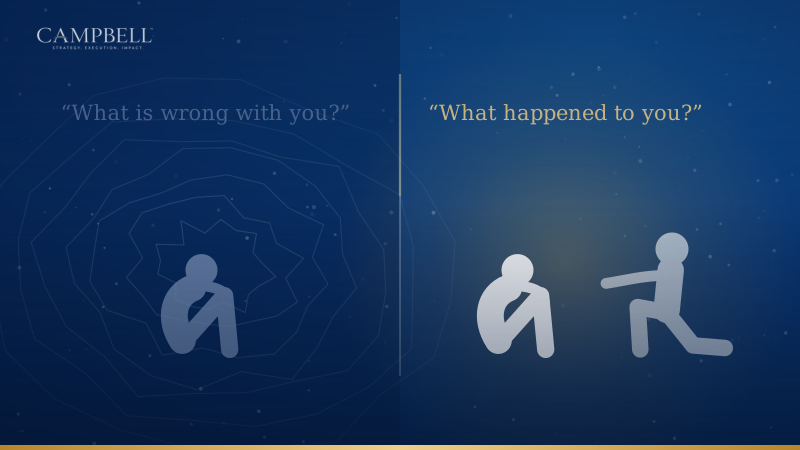
There is another reading available, and it changes what an organization does next. The question is not what is wrong with this person. The question is what might have happened to them, and what is happening to them right now, in this building, with us.
This is not a soft topic
Trauma is common among the people nonprofits serve, and it is common among the people nonprofits employ. It shapes behavior, engagement, and trust whether or not anyone ever discloses it. Most of the time nobody does.
What trauma does, physiologically, is make the nervous system very good at detecting threat and very poor at reasoning under it. Fight, flight, freeze, and fawn are not character traits. They are survival responses, and they fire faster than thought. A person in that state cannot be reasoned with, not because they are unwilling but because the part of the brain you are appealing to is temporarily offline.
That has a direct operational consequence. A policy that depends on people absorbing information, following multi-step instructions, and staying regulated in a stressful environment will fail with a predictable share of the people it is meant to serve. Then the organization records that failure as their non-compliance.
Many of the challenges in community programs are trauma-driven rather than motivation-driven. The two look identical on a case note and call for opposite responses.
What it costs when you are not
The case for this work is often made on compassion alone, which is true but incomplete, and it tends not to survive a budget conversation. The sturdier case is operational.
- Your outcomes understate what you can do. People who disengage early never reach the part of the program that works. The intervention is not failing. It is not being received.
- Incidents rise, and so does their severity. Escalation almost always has early warning signs. Staff who have not been taught to read them meet the escalation at its peak instead of its beginning.
- Staff leave. Direct-service work carries secondary traumatic stress as a condition of the job. Where that goes unnamed and unsupported, it is experienced as personal failure, and good people conclude they are not cut out for it.
- You pay for turnover twice. Once in recruitment and training, and again in the relationships that leave with the person. For a population whose trust is hard to earn, staff churn is a programmatic problem, not only an HR one.
- Funders increasingly ask. Trauma-informed practice now appears in procurement language and in reporting requirements. Organizations that cannot describe theirs are answering a harder question than they need to.
The part most organizations get wrong
Trauma-informed care is usually purchased as a workshop. Staff attend, the material is good, people leave moved by it, and six weeks later the practice has evaporated. Not because the training was poor, but because the organization did not change around it.
If being trauma-informed depends on individual staff remembering to be, the organization is not trauma-informed. It is employing some people who are, for as long as they stay.
The distinction matters because the things that re-traumatize people are rarely interpersonal. They are structural. A waiting room with no clear exit. An intake form that asks for the worst day of someone's life before anyone has earned the right to hear it. A rule enforced without explanation. A schedule that offers no choice. None of those are fixed by a kinder caseworker.
What it looks like in practice
The widely used framework comes from SAMHSA and rests on four actions: realize how common trauma is, recognize how it shows up, respond by building it into practice, and actively resist re-traumatizing people. Six principles follow from that, and each one is visible in things an organization decides rather than things staff feel.
- Safety. Physical and emotional. Where people sit, how the space is lit, whether someone can see the door, and whether raising a concern is survivable.
- Trustworthiness and transparency. Decisions are explained. Rules are consistent. People are told what will happen before it happens.
- Peer support. People who have been through it are part of the service, not only recipients of it.
- Collaboration and mutuality. The power difference between staff and participant is acknowledged and deliberately narrowed.
- Empowerment, voice, and choice. Real options, not the appearance of them. Choice is the most direct antidote to an experience defined by having none.
- Cultural, historical, and gender considerations. Recognizing that for many communities the harm was institutional, and your organization is an institution.
Read that list as an audit rather than a philosophy. Walk your own intake process against it. Most organizations find two or three things they could change this quarter that would matter more than any training.
Your staff are in this too
There is a version of this work that asks frontline staff to absorb everything and offers them nothing, and it does real damage. People who spend their days close to other people's trauma carry some of it. That is not weakness and it is not unusual. It is the predictable cost of the work.
An organization that takes this seriously plans for it: clarity about what staff are authorized to do, permission to step back, and reliable backup when a situation turns. Where those three are missing, staff safety rests entirely on individuals being good at de-escalation, which is a system that has already failed.
Post-incident support belongs in policy, not in goodwill. So does workload, supervision that is not only about compliance, and a leadership position that burnout is an organizational signal rather than a personal shortcoming.
Where to start
This does not begin with a policy rewrite. It begins with looking honestly at what a person experiences from the moment they contact you.
- Walk your own front door. Call your own intake line. Sit in your own waiting area. Read your own intake form as though it were being asked of you.
- Ask what your forms ask, and why. Every question about history should have a clear use. The ones that do not are extraction, and people can tell.
- Find the three moments where people most often drop out. Your data already knows. Look at what happens immediately before each one.
- Name the staff safety question out loud. Ask your team what they are unsure they are allowed to do. The answers are usually specific and quickly fixable.
- Decide who owns this. Trauma-informed practice that belongs to everyone in general belongs to no one in particular.
None of that requires a budget line. It requires leadership attention, which is the scarcer resource, and a willingness to hear something uncomfortable about a process someone in the building designed.
Why it is worth doing properly
When this work is built into systems rather than left to individuals, something specific happens. The organization itself becomes a source of safety. People stay engaged long enough for the program to work. Incidents decline. Staff last longer. The outcomes you report start to reflect what your model can actually do.
That is a different conversation to have with a board or a funder than one about compassion, and it happens to be true.
Related Service
The Workshops and Training Engagement
Every workshop is adapted before it is delivered. See the series in full, the other workshops we run, and how to bring one to your team.
Explore the engagement →