
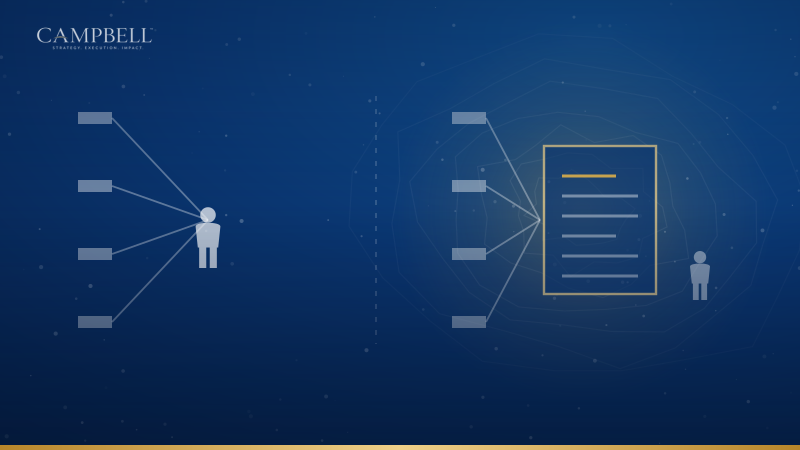
Maria is out for two weeks. Nothing catastrophic happens, but the intake backlog grows, two reimbursements sit unprocessed because nobody is certain who approves them, and a volunteer is told three different things about how to log a donation.
When Maria returns she clears it in a day and a half, which everybody treats as a happy ending. It is actually the diagnosis.
A policy is not a procedure
These get used interchangeably and they are different documents doing different jobs.
- A policy says what the organization does and why. Expenditures over a threshold require two approvals. Client records are retained for seven years. It is a rule, usually board-adopted, and it rarely changes.
- A procedure says how. Who opens the request, what they check, where it goes next, what happens when a receipt is missing. It belongs to staff, it changes whenever the work changes, and it is what somebody actually follows on a Tuesday.
Plenty of organizations have a well-maintained policy manual and almost no procedures, and then wonder why the policy is applied inconsistently. The policy was never the part people needed. They knew the rule. They did not know the steps.
Why this bites a nonprofit harder
Every organization loses knowledge when people leave. A few features of nonprofit operations make it sharper.
- Turnover is higher and the bench is thinner. In a team of nine, one departure can take an entire function with it.
- Much of the work is part-time or shared. A process performed two days a week by one person and covered by somebody else on Thursdays will drift into two versions unless it is written down.
- Volunteers rotate constantly. You cannot train each one personally, and the quality of what they do is set by the clarity of what you handed them.
- Founders carry processes in their heads. It is efficient right up until it is the organization's largest single risk.
- Funders and auditors ask. Not whether you are careful, but whether the control exists and is followed. A documented procedure is the difference between describing your practice and evidencing it.
The test is whether a competent stranger could do it
Not an expert. Not somebody who already knows. A capable person who has never performed this task, holding your document, with nobody to ask.
That standard rules out most of what gets written, because procedures are usually written by people who know the job too well to notice what they are assuming. They write “process the invoice” because to them that is one action. To the stranger it is six, two of which involve a decision nobody has explained.
If somebody has to ask one question to use your procedure, that question is the thing the procedure was missing. Write the answer into it rather than answering it again next month.
The person who does the work should write it
Directors write procedures describing the process as designed. The person performing it writes the process as performed, and the gap between those two is where the useful information lives.
The most effective method is unglamorous: have them do the task while somebody else writes down what they actually do, including the parts they have stopped noticing. Written from memory, procedures quietly omit the workaround that makes the whole thing function.
How a good one earns its keep
Four returns, and most organizations only anticipate the first.
- Onboarding stops consuming a senior person. New staff and volunteers get further on their own, and the questions they do ask are better ones.
- Absence stops being disruption. Planned leave, illness and resignation become inconvenient rather than destabilizing.
- Audits and grant monitoring get shorter. You hand over the document instead of reconstructing the practice from memory under deadline.
- Disagreements get settled quickly. When two people are each certain the process is different, the written version ends it, and if the written version is wrong you have found something worth fixing.
They go stale, and only one thing prevents it
A procedure written once and never revisited becomes fiction within about a year. The system changes, a step gets added, somebody finds a better way, and the document quietly stops describing reality. At that point it is worse than nothing, because new staff follow it and are then corrected by colleagues, which teaches them that the written procedures are not to be trusted.
The preventive is ownership rather than discipline. One named person per procedure, a review date on the document itself, and a standing moment, usually annual, when each owner confirms it still matches what happens. Ten minutes a procedure. The alternative is a library that nobody believes.
What an SOP is not
- Not a substitute for judgment. Document the routine so people have more attention for the situations that genuinely need thought.
- Not required for everything. If a task is performed once a year by one person and carries no risk, leave it alone.
- Not a performance management tool. The moment procedures are used to catch people out, they stop describing what actually happens.
- Not a sign of bureaucracy. The bureaucratic organization is the one where nobody can act without asking, which is precisely what undocumented process produces.
Where to start
Not with everything. That project never finishes and the output goes unread. Pick the one process whose absence hurt most recently, have the person who performs it write it while doing it, keep it to a page, and give it an owner and a review date.
Then do another one next month. For the question of which processes to prioritize, and the broader signs that informal systems have stopped carrying the organization, this piece on growing out of your systems works through it. For a new organization, building these alongside the governance and financial foundation is considerably cheaper than retrofitting them later.
None of this is sophisticated work. It is the kind of thing that never feels urgent until the week it is the only thing that matters, and the organizations that have it are rarely the ones with the most process discipline. They are the ones that wrote something down the last time somebody was out.
Related Service
The Process Improvement Engagement
See how a CAMPBELL process improvement engagement maps how work actually moves, redesigns it, and builds in the controls that keep it fixed.
Explore the engagement →